
SAP Business One Cloud
SAP Business One Cloud Services
Moving ERP to a hosted environment changes more than where servers run. Macrofix can help assess your workflows, integrations, user access and operational requirements, then document a deployment and transition plan with clear ownership. Compare the proposed arrangement against your current system before approving a move.
Discuss Your Cloud Deployment
Choose the deployment model before choosing the infrastructure
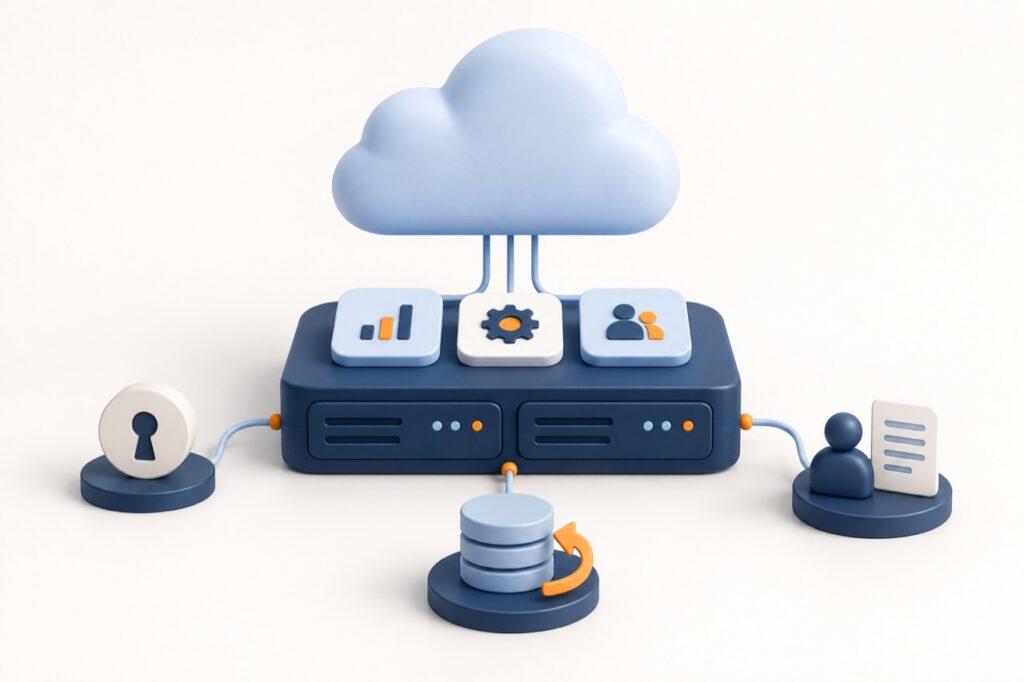
A useful cloud proposal connects business requirements to a supported deployment model. Assess access, dependencies, control, capacity and costs before selecting infrastructure. SAP technical information identifies cloud and on-premises options; supported configuration and supplier terms must be checked for your environment. Explore our SAP Business One services for related project needs.
Cloud planning services with defined responsibilities
Define the application environment, infrastructure responsibilities and transition decisions together. The services below focus on deployment planning, not a blanket hosting promise. License supply, application implementation, data conversion and recurring operations have separate scopes unless explicitly included in the proposal.
Deployment-fit assessment
Review user locations, working hours, transaction patterns, reporting, integrations and add-ons. Document constraints and investigate compatibility with the proposed environment rather than assume every component can move unchanged.
- Deployment-fit findings
- Supported configuration review
- Capacity and connectivity assumptions
- Supplier responsibility matrix
Hosting architecture and sizing
Define production and test environments, connectivity, capacity assumptions and responsible providers. Confirm the supported configuration for the product version and database platform. Any hosting proposal must identify who contracts for infrastructure, licenses and operations.
- Authorized access design
- Backup and retention ownership
- Representative restore test
- Transition and rollback decisions
Access and security design
Plan authorized user access, administrative permissions, remote connectivity and credential handling. Agree responsibility for security configuration and review. Cloud placement alone is not proof of privacy, regulatory compliance or secure operation.
- Documented acceptance criteria
- Recurring cost assumptions
- Operational handover record
- Visible unresolved limitations
Backup and recovery planning
Specify backup ownership, retention, restore procedures and recovery objectives. Test a representative restore and record the result. A successful backup job is not evidence that the service can recover within a promised time.
Transition and operational handover
Agree rehearsals, validation, cutover decisions, rollback conditions and post-transition ownership. New implementations and data-conversion work have separate scopes. Record acceptance before approving changes to any prior environment.
Inputs for a meaningful deployment assessment
Use an agreed inventory to evaluate deployment fit. Collect system facts through authorized channels, not the public enquiry form. Missing compatibility, supplier or licensing information remains an open decision rather than an assumed approval.
- Installed version, platform and current environment owner
- Add-on, interface and reporting inventory
- Data location, retention and customer policy requirements
- Availability needs and recovery objectives
- License, maintenance and supplier arrangements
- Named business and technical decision owners
Agree operational ownership before launch
Create a responsibility matrix for application administration, operating system and database management, patching, backup, recovery, monitoring, security events and vendor escalation. State what the proposed service includes and what remains with the customer or another supplier. Confirm provider location and contractual terms before making residency claims.
- Identify application and infrastructure owners
- Define patching and monitoring responsibilities
- Agree backup, recovery and escalation ownership
- Confirm provider terms and location
A tested path from assessment to transition
Assess the current deployment, compare feasible models, document architecture and costs, and test a representative environment. Authorize transition only after reviewing findings, then validate business workflows and hand over operations.
- Assess workflows and deployment constraints
- Compare feasible models and document costs
- Test the proposed environment and dependencies
- Authorize transition with rollback conditions
- Validate and hand over operational ownership
Acceptance evidence for the proposed environment
Acceptance evidence should include permitted access tests, representative workload results, dependency checks, restore-test records, agreed transition decisions and the final ownership matrix. Keep unresolved limitations visible rather than hiding them behind a generic launch checklist.
- Authorized access tests recorded
- Representative workload and dependency checks
- Restore-test evidence against agreed objectives
- Business validation and transition decisions
- Final ownership matrix and open limitations
SAP Business One Cloud FAQs
No. Compare access, dependencies, control, capacity, operational ownership and costs against your requirements. Recommend a model only after assessment.
A feasibility assessment can investigate the current version, data, extensions and target environment. The move, any upgrade and any data transformation require an agreed scope and tested plan.
These are different product families. This engagement concerns Business One deployment, not a renamed S/4HANA implementation. Explore our SAP S/4HANA services for that product family.
Only where explicitly stated in the offer. Identify the licensing provider, infrastructure provider and their separate terms. A planning engagement does not automatically include licenses or a hosting subscription.
There is no blanket guarantee. Document service objectives, exclusions, provider commitments and test evidence in the agreement. Response, restoration and full business recovery are different measures.
User needs, environment size, interfaces, platform, availability design, transition work and operational scope. Compare one-time project fees and recurring costs within a scoped proposal rather than assuming a universal monthly price.
Plan your SAP Business One deployment
Tell us which business workflows, access needs and deployment decisions you want to assess. We can discuss a scoped planning engagement with defined deliverables and supplier responsibilities. Do not submit credentials, confidential records or detailed system configuration through the public form.