
SAP Process Assessment
SAP Best Practices & Fit-to-Standard Consulting
Compare your business scenarios with the standard processes available in the selected SAP product and edition. Macrofix can scope fit-to-standard workshops, document justified gaps and turn decisions into configuration inputs and a prioritized backlog. Business owners approve process changes before delivery commitments.
Discuss Your SAP Process Assessment
Test Standard Process Fit Before Committing to Build
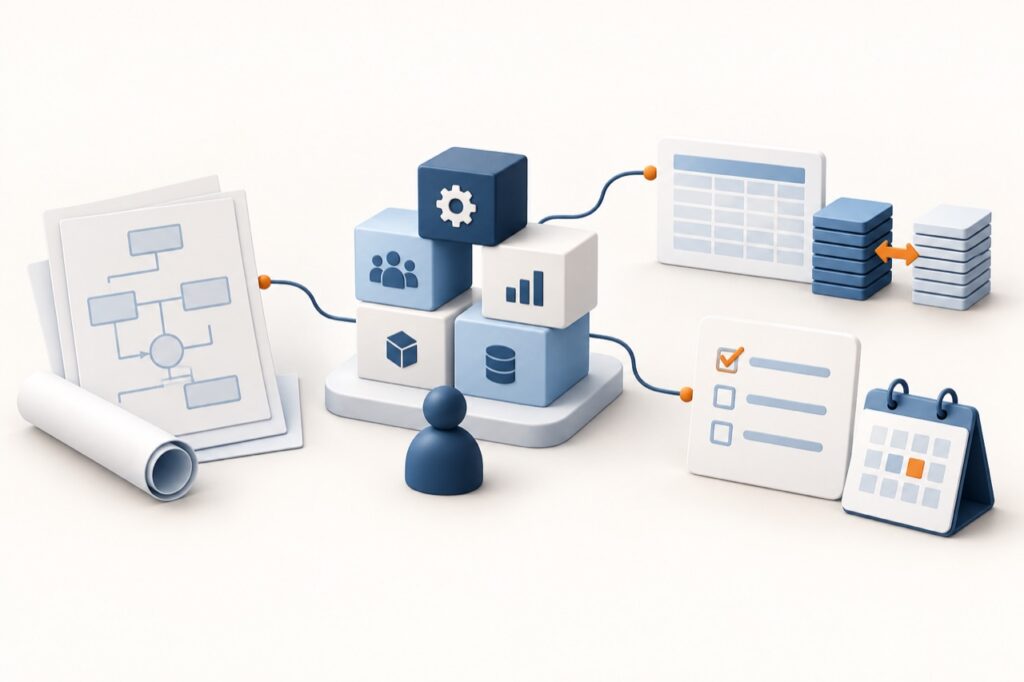
A familiar process is not always a requirement to reproduce every legacy screen. A standard process is not automatically right for every business either. An assessment makes the difference visible: what can be adopted, what needs configuration and what has a justified gap.
Use this service for process-level assessment and workshop outputs. For the wider product roadmap, explore SAP consulting services. Implementation and ongoing operations remain separately scoped workstreams.
Fit-to-Standard Assessment Workstreams
Start with named business scenarios, the intended SAP product and edition, and the people who can approve changes. The assessment records fit and gaps against available reference processes, not an assumed universal template. Each workshop should produce decisions and usable delivery inputs rather than only a demonstration.
Scope, Edition & Workshop Preparation
Identify in-scope processes, countries, organizational units and integrations. Select relevant reference content for the target product and release, confirm appropriate system access and agree workshop participants. Use representative synthetic scenarios that business owners can review.
Preparation includes the current-process summary, critical exceptions and questions that need a decision. If a demonstration environment or reference process is unavailable, record the limitation before treating the workshop as evidence of product fit.
- Target product, edition and release
- In-scope business scenarios and countries
- Named workshop participants and approvers
- Reference content and environment readiness
Standard Process Review with Business Owners
Review the selected process with business owners from beginning to end, including roles, business documents, approvals and exceptions. Compare it with the outcome the organization needs, and capture configuration values and adoption changes while the discussion is concrete.
SAP describes fit-to-standard workshops as a way to review standard processes and document gaps for the selected S/4HANA Cloud scope. We apply product-appropriate assessment boundaries rather than assume identical content across every SAP application.
- Standard process and exception review
- Business fit and adoption decisions
- Configuration values and role inputs
- Justified gaps and unresolved questions
Gap Decisions & Extension Justification
Classify each difference as an adoption decision, configuration need, integration requirement, extension candidate or unresolved product-fit issue. Record the business reason and owner. Distinguish mandatory requirements from preferences inherited from the current system.
Compare options against maintainability, release impact, data controls and delivery effort before approving custom work. A gap log is a decision aid, not permission to build every request or a guarantee that a proposed extension is supported.
- Prioritized delivery backlog
- Integration and data dependencies
- Extension options and release impact
- Traceable acceptance scenarios
Configuration, Data & Integration Inputs
Capture the configuration values, master-data needs, roles, reporting requirements and interface dependencies that the approved process requires. Connect each input to its process owner and acceptance scenario so the implementation team knows what must be validated.
Mark assumptions that need technical verification, including country features, API availability and data-quality constraints. Do not promote a workshop preference into production configuration without the appropriate review and approval.
Prioritized Backlog & Rollout Decisions
Turn accepted requirements into a backlog with process boundaries, priorities, dependencies and review criteria. Separate assessment findings from confirmed implementation estimates. Identify decisions that can change the rollout sequence or require a follow-on design workshop.
For an S/4HANA delivery programme, continue with S/4HANA implementation services. Platform extensions and interfaces can be scoped through SAP BTP consulting.
A Decision Register Your Delivery Team Can Use
The assessment pack records which scenarios were reviewed, the selected product and release, process-fit conclusions and approved gaps. Include the evidence and owner behind each decision, configuration inputs and unresolved questions.
Keep traceability from a business requirement to its planned delivery item and acceptance check. The result supports funding and scope decisions; it does not replace detailed solution design, testing or a separate statement of work.
- Assessed processes and scope boundaries
- Reference product and release context
- Fit conclusions and workshop evidence
- Gap reasons, options and decision owners
- Configuration, data and interface inputs
- Priorities, dependencies and open decisions
Keep Product Scope and Business Authority Clear
Reference processes and best-practice content depend on the SAP product, edition, release and country scope. Verify current availability and access rights before using vendor materials. Macrofix does not imply certification, vendor partnership or unrestricted redistribution of SAP-owned content.
Your organization retains authority for policies, regulatory interpretation and business-process approval. Standard configuration does not automatically establish legal compliance or a clean-core outcome. Sensitive records and credentials stay outside public forms and shared workshop samples.
- Verify reference scope and content access rights
- Retain customer policy and process authority
- Separate assessment from delivery commitments
- Use synthetic examples and secure records handling
From Workshop Preparation to Approved Scope
Agree scope and readiness before scheduling the assessment. Review selected scenarios with the relevant owners, record fit and gaps, then validate the resulting inputs and backlog. Open decisions need named owners and a next action before final scope approval.
The assessment can be phased by business area so decisions remain manageable. Delivery estimates, subscriptions and production commitments are confirmed separately after the requirements and dependencies are understood.
- Agree process scope and workshop readiness
- Review standard scenarios with business owners
- Record fit, configuration inputs and justified gaps
- Validate dependencies and backlog priorities
- Approve the decision pack and next workstreams
Evidence for Assessment Acceptance
Acceptance means the agreed scenarios have been reviewed and the outputs are usable by business and delivery teams. Check that fit conclusions have evidence, gaps have business reasons and configuration inputs have owners. Record omitted scenarios and unverified assumptions explicitly.
Business owners approve the decision register and priorities. Technical owners review feasibility dependencies. A completed assessment is not a go-live approval; implementation testing, security review and operational readiness still follow.
- Agreed scenarios reviewed or limitations recorded
- Fit and gap decisions backed by evidence
- Named owners for configuration and dependencies
- Prioritized backlog and acceptance traceability
- Business approval and tracked open questions
SAP Best Practices & Fit-to-Standard FAQs
It compares agreed business scenarios with the standard processes available in the selected SAP product and edition. The output records adoption decisions, configuration inputs, justified gaps and a prioritized backlog. It is not a promise to reproduce every legacy workflow.
No. Reference content varies by product, edition, release and country scope. We verify the content and access available for your assessment. A S/4HANA Cloud workshop method should not be treated as proof that every other SAP application has identical processes.
Not automatically. The assessment first examines adoption and configuration options. A justified gap may need integration, an extension or a different product-fit decision. Feasibility, supportability and delivery effort must be reviewed before custom work is approved.
Provide a non-sensitive summary of current processes, required outcomes, critical exceptions, countries and system dependencies. Nominate process owners who can approve changes. Workshop samples should be synthetic; confidential records require separately approved handling.
Only the agreed assessment deliverables are included in its scope. Product subscriptions, technical implementation, detailed design, testing and production operations are separate commitments. Estimates depend on approved requirements and verified dependencies.
No. It establishes process and scope decisions for the next workstream. Production readiness still requires implementation evidence, data reconciliation, access checks, user acceptance, cutover and operating ownership appropriate to the project.
Plan Your Fit-to-Standard Assessment
Tell us the SAP product you are considering or using, the processes you want to assess and who will approve business changes. Macrofix can propose a workshop scope and decision pack. Explore SAP platform and cloud services for related applications. Do not include confidential employee, customer or financial records in your public enquiry.